

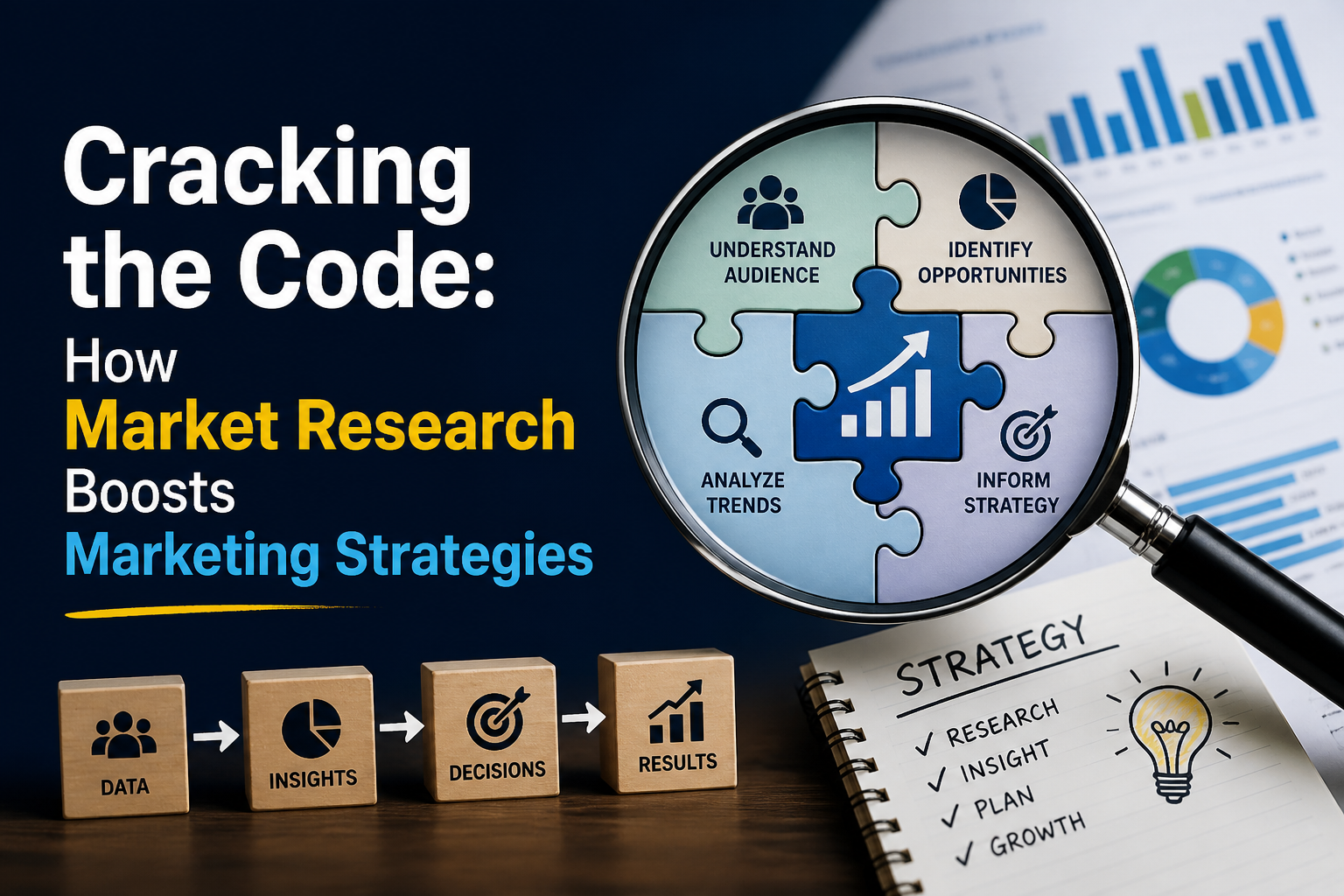
Marketing can feel like a puzzle: you have a product, a budget, and a message—but which customers will respond, and what will persuade them to act? Market research helps you find those answers before guesswork drains your time and resources. By listening to customers and studying the market, you can turn scattered clues into a clearer strategy.
That insight becomes practical when you connect research methods to marketing decisions:
| Research method | What it reveals | How it strengthens marketing |
|---|---|---|
| Customer surveys | Needs, preferences, and satisfaction | Sharpen messages and offers |
| Competitor analysis | Gaps, positioning, and market trends | Help your brand stand out |
| Customer interviews | Motivations and buying barriers | Improve campaigns and customer journeys |
Once you know what your audience values and where competitors fall short, you can make more confident choices about positioning, channels, and creative. In this article, we’ll explore how market research helps marketers understand their customers, spot opportunities, and build strategies that connect with the right people.
Why Market Research Matters to Modern Marketing
Marketing works best when it starts with evidence rather than assumptions. Market research helps businesses understand who might buy their products, what those customers value, and how they make decisions. It turns scattered observations into useful patterns that teams can apply to product positioning, campaign planning, pricing, and customer experience. Without research, marketers risk spending time and budget on messages that miss their audience or channels that fail to reach them. With reliable insight, they can set clearer priorities and explain why a strategy should work. Research does not remove uncertainty, but it gives marketing teams a stronger foundation for making informed choices.
Research also connects marketing activity to real customer needs. A team may believe buyers care most about low prices, while interviews reveal that convenience or dependable service matters more. Those distinctions change how a business presents its offer and where it invests. Market research can expose unmet needs, reveal how customers describe their problems, and show which benefits stand out in a crowded category. It also helps teams spot differences between customer groups instead of treating every buyer alike. By grounding decisions in observed behavior and feedback, marketers can build strategies that feel relevant, support business goals, and adapt as customer expectations change.
Replace Assumptions with Evidence
Every marketing plan contains assumptions: a target audience will respond to a certain message, a product solves a meaningful problem, or a channel will reach likely buyers. Research gives teams a way to test these beliefs before they commit significant resources. Surveys can measure how widely a view is shared, while interviews help explain why people hold it. Website analytics and sales data show what customers actually do, which may differ from what they say. Combining these sources lets marketers distinguish a promising idea from a convenient guess. They can then adjust the strategy early, reducing wasted effort and making decisions easier to defend.
Evidence becomes most useful when teams connect it to a specific decision. Rather than asking broadly whether a campaign seems appealing, marketers can test which benefit customers understand, which audience recognizes the problem, or which call to action encourages a next step. They should document the original assumption, the evidence collected, and the resulting decision. This habit makes research practical instead of ornamental. It also helps teams recognize when findings are uncertain or limited to a small sample. A disciplined process does not guarantee success, but it prevents confident opinions from silently shaping budgets, creative choices, and customer promises without adequate support.
Connect Customer Needs to Business Goals
Research gains strategic value when customer insight links to outcomes the organization wants to achieve. A study might uncover frustration with onboarding, but marketers need to understand how addressing it could improve activation, retention, referrals, or revenue. This connection helps teams prioritize findings rather than treating every customer comment as equally urgent. It also encourages collaboration across marketing, product, sales, and service teams. Each function may see a different part of the customer journey, so shared evidence can reveal where a change would have the greatest effect. Translating needs into business goals gives research a clear purpose and makes its recommendations easier to act on.
Teams can create this connection by defining the decision and success measure before conducting research. If the goal is to attract more qualified leads, researchers might investigate which buyers have the strongest need, what information they require, and what creates confidence. If the goal is retention, they may examine why customers stay, struggle, or leave. The resulting insights should guide practical choices, such as changing a message, improving a touchpoint, or refining an audience. Marketers should avoid claiming that one finding will automatically produce a business result. Instead, they can set a measurable hypothesis and monitor whether the chosen action improves the intended outcome.
Understand the Audience Behind the Data
Effective marketing depends on more than knowing a customer’s age, location, or job title. Teams need to understand the tasks people are trying to complete, the obstacles they face, and the benefits they seek. Research brings these motivations into view through interviews, observation, surveys, customer conversations, and behavioral data. It helps marketers describe audiences in ways that explain decisions rather than merely label people. A useful audience profile clarifies what a person needs, what influences their choices, and what might prevent them from responding. These details help teams shape relevant offers and communication without relying on stereotypes or broad demographic shortcuts.
Audience understanding should also reflect differences within a market. Two people who appear similar on paper may have different levels of product knowledge, urgency, budget, or trust. Conversely, customers from varied demographic groups may share the same need and respond to the same benefit. Research helps marketers identify meaningful patterns while avoiding unnecessary complexity. The goal is not to create endless segments, but to find distinctions that change a marketing decision. When teams understand how customers think and act, they can select clearer language, more useful content, and better moments to communicate. That relevance can improve both the customer experience and the efficiency of marketing investment.
Build Useful Customer Segments
Customer segmentation groups people according to characteristics that help a business serve and reach them more effectively. Marketers can segment by needs, behaviors, purchase stage, product usage, value, or preferences, as well as by demographic or geographic traits. Research helps determine which distinctions matter. A segment becomes useful when its members share a relevant problem or response and when the business can reach them with a suitable offer. Teams should avoid segmenting simply because data makes it possible. Too many groups can fragment budgets and complicate execution. Begin with a small set of evidence-based segments, then test whether tailored strategies perform better than a broad approach.
Teams can assess a potential segment by asking whether it is identifiable, meaningfully different, reachable, and large or valuable enough to serve. They should also consider whether the organization can meet the group’s needs and whether the segment supports its objectives. For example, a software company might distinguish first-time users who need guidance from experienced users who want advanced controls. The groups may need different messages and onboarding experiences. Researchers can validate these distinctions through customer interviews, usage patterns, and campaign tests. Segments should remain flexible: as products, markets, and customer behavior change, marketers should revisit whether each group still offers a practical basis for decisions.
Map Motivations, Barriers, and Buying Journeys
Understanding motivations means learning what customers hope to accomplish, not just what product category they browse. Interviews and open-ended surveys can reveal desired outcomes, emotional concerns, and the language people naturally use. Research should also uncover barriers, such as price concerns, confusing instructions, lack of trust, or difficulty comparing alternatives. These obstacles can explain why a person who seems interested does not purchase. Marketers can use these findings to answer questions, clarify benefits, and improve the experience. They should distinguish frequently observed barriers from isolated anecdotes, then investigate important patterns with additional evidence before changing strategy or making broad claims about customer behavior.
A buying journey map organizes what customers do and need as they move from recognizing a problem to evaluating options, purchasing, and using a solution. Research can show which questions arise at each stage, what sources people trust, and where they abandon the process. The map should describe the customer’s experience rather than reproduce an internal sales funnel. For example, buyers may compare products before contacting a sales team, or return to earlier research after receiving new information. Teams can combine customer interviews, analytics, support records, and sales feedback to understand these moments. A clear journey helps marketers deliver useful information at the right time and identify friction that deserves attention.
Read the Competitive Landscape
Market research helps businesses understand the alternatives customers consider, including direct competitors, indirect solutions, and doing nothing. This wider view matters because customers compare outcomes, not just product specifications. A buyer may choose a competing service, use a manual workaround, or postpone the decision entirely. Research can reveal how alternatives position themselves, what customers appreciate about them, and where people remain dissatisfied. These insights help marketers identify credible points of difference rather than repeat familiar category claims. They also prevent teams from defining the market too narrowly. A useful competitive view connects what businesses offer with how customers actually evaluate available choices.
Competitive research should inform strategy without encouraging imitation. Copying a rival’s headline or channel plan may overlook differences in audience, product, budget, and brand credibility. Instead, teams should examine how alternatives meet customer needs and where the market leaves important needs unresolved. They can compare promises, pricing approaches, service experiences, distribution, and public customer feedback, while checking information against multiple sources. Findings should distinguish observable facts from interpretation: a rival’s published price is a fact, while the reason customers prefer it may require research. This discipline helps marketers make defensible choices about positioning, investment, and product communication in a changing marketplace.
Identify Competitors and Alternatives
Start by defining the customer problem your offer addresses, then list the ways people currently solve it. Direct competitors sell similar products to similar customers. Indirect competitors address the same need through a different kind of offer, while substitutes may include an internal process, a free tool, or a decision to wait. Customer interviews can uncover alternatives that a standard industry list misses. Search behavior, sales conversations, reviews, and support requests can add further clues. Once the set is defined, marketers can focus research on the alternatives customers genuinely consider. This customer-centered view produces more useful comparisons than a list based only on company category or brand awareness.
Teams should evaluate competitors using consistent criteria, such as audience, promise, price structure, key features, distribution, support, and proof offered. Consistency makes it easier to identify patterns and gaps without overemphasizing a single striking example. Researchers can use public websites, product trials, published reports, customer feedback, and sales intelligence, while noting when data is incomplete or outdated. They should avoid assuming that a competitor’s marketing claims reflect the full customer experience. Instead, compare claims with independent evidence where available. The purpose is not to produce an exhaustive dossier; it is to understand the choices available to customers and identify where your own offer can provide meaningful value.
Find a Differentiated Position
A differentiated position explains why a particular audience should choose an offer over relevant alternatives. Research supports positioning by identifying benefits customers value, weaknesses in existing options, and reasons people believe one provider more than another. Marketers should look for a space where customer demand, organizational capability, and credible proof overlap. A business cannot sustain a distinction that it cannot deliver, and an unusual message has little value if buyers do not care about it. Teams can test positioning statements with target customers to assess clarity, relevance, believability, and uniqueness. Their feedback helps refine the promise before it becomes central to campaigns, sales materials, or product decisions.
Use a comparison table to make the reasoning visible, but treat the entries as research hypotheses until teams verify them with customers and reliable evidence. The table should compare benefits that matter, not simply count features. It can help teams decide which advantage to emphasize, where they need stronger proof, and which claims risk sounding interchangeable. Marketers should revisit the comparison as competitors adjust their offers and customers change their priorities. A useful position does not need to claim superiority in every area. It should communicate a meaningful, supportable reason to choose the brand for a particular need, while leaving room for the product and customer experience to substantiate the promise.
| Comparison area | Your offer | Alternative A | Alternative B | Research question |
|---|---|---|---|---|
| Primary benefit | What outcome do you promise? | What outcome does it promise? | What outcome does it promise? | Which outcome matters most to buyers? |
| Price and value | How is the offer priced? | How is it priced? | How is it priced? | How do customers judge value? |
| Ease of use | What makes adoption easier or harder? | What makes adoption easier or harder? | What makes adoption easier or harder? | Where do customers experience friction? |
| Proof and trust | What evidence supports the claim? | What evidence supports the claim? | What evidence supports the claim? | Which evidence builds confidence? |
Turn Insights into a Stronger Marketing Strategy
Research creates value when teams convert findings into decisions about audience, offer, message, channel, and timing. A report alone does not change customer experience or business performance. Marketers need to interpret what the evidence means, decide which opportunities deserve attention, and assign clear actions. This process often involves trade-offs: a campaign cannot speak equally to every segment, and a limited budget cannot support every promising channel. Research helps teams make those trade-offs transparently. By tying each action to a finding and a strategic goal, marketers can explain why a plan prioritizes particular customers and how they will judge whether the approach works.
Strong strategies turn insight into a consistent experience across touchpoints. A promise in an advertisement should align with the landing page, sales conversation, product experience, and customer support. Research can show where those interactions conflict or where customers need reassurance. Teams can then create messages that address real priorities and coordinate them across channels. The strategy should remain specific enough to guide choices, yet flexible enough to respond to new evidence. Marketers can document the audience, customer problem, value proposition, supporting proof, channel roles, and success measures. This shared direction helps creative, media, sales, and product teams work toward a coherent customer outcome.
Shape Messaging Around Customer Language
Customer language makes marketing easier to understand because it reflects how people describe their needs, concerns, and desired outcomes. Researchers can collect this language through interviews, review analysis, search queries, support conversations, and sales calls. The goal is not to copy every phrase word for word, but to learn which terms customers recognize and what they mean by them. Teams should preserve accurate context: a vivid quote from one person does not prove that an entire audience uses the same words. When marketers validate recurring themes, they can write clearer headlines, product descriptions, and calls to action that connect the offer to customer priorities.
Message testing can compare different ways of presenting the same underlying benefit. Teams might test a convenience-focused message against one centered on reliability, then ask target customers what they understand, believe, and want to know next. They can also measure behavior through controlled campaign experiments, while avoiding conclusions from small or poorly matched samples. A message should be clear and compelling, but it must also match what the product actually delivers. Research can reveal when a creative phrase attracts attention yet creates confusion or unrealistic expectations. Marketers should refine language based on both comprehension and performance, then monitor whether it continues to resonate with the intended audience.
Choose Channels That Match Audience Behavior
Channel choices should reflect where target customers look for information, how they prefer to interact, and what role each channel can play in their decision. Research can identify trusted sources, common search behavior, media habits, and differences across audience segments. Marketers can combine customer interviews with analytics, campaign history, and sales feedback to form a practical channel plan. Popularity alone does not prove that a channel suits a particular objective. A platform may generate awareness but produce few qualified leads, while a less visible channel may support consideration or retention. Teams should define the job of each channel and connect it to an audience need.
Marketers should treat channel plans as hypotheses that require testing. A small pilot can reveal whether a channel reaches the intended people, earns attention, and encourages the desired next step. Teams should compare performance using suitable measures, such as qualified engagement, conversion, or customer acquisition cost, rather than relying solely on impressions or clicks. They should also consider how channels work together. A customer may discover a product through one source, research it elsewhere, and convert after receiving a follow-up message. Attribution rarely captures every influence perfectly, so teams should combine measured performance with customer feedback. They can then shift resources toward channels that contribute meaningfully to the strategy.
Select Research Methods That Fit the Question
Good research begins with a focused question, not a preferred tool. Teams should first identify the decision they need to make, the information they lack, and the consequences of getting it wrong. Qualitative methods help explain attitudes, language, and context, while quantitative methods can estimate patterns across a larger group. Existing data may answer a question faster than a new study, but it may not capture the precise audience or issue. Choosing an appropriate method saves time and improves the usefulness of findings. Researchers should also consider cost, access, timing, privacy, and the level of confidence the decision requires before designing a study.
Combining methods often produces a fuller view than relying on one source. Interviews can suggest why customers behave a certain way, while analytics can show how often a behavior occurs. Surveys can assess whether a theme appears across a broader group, and experiments can test whether a change affects an outcome. Researchers should avoid presenting any single method as universally reliable. Each has limits: self-reported answers may differ from behavior, tracking data may lack context, and experiments may not reflect every market condition. Clear research design explains what the evidence can support and where uncertainty remains, helping decision-makers use findings responsibly rather than overstate conclusions.
Use Qualitative and Quantitative Research Together
Qualitative research includes interviews, focus groups, observation, and open-ended feedback. It helps teams explore how customers understand a problem, what language they use, and why they respond in particular ways. Quantitative research includes surveys, structured measurement, and analysis of numerical behavior. It helps estimate how common a pattern is or compare responses across groups. A practical sequence might begin with interviews to uncover possible concerns, followed by a survey to assess how widely those concerns appear. Teams can also use quantitative findings to select people for follow-up conversations. This combination supports both depth and breadth, provided marketers recognize that each method answers different questions.
Researchers should match the sample and instrument to the decision. Interviews need participants with relevant experience, and surveys need clear wording, suitable response choices, and enough appropriate respondents to support the intended analysis. Teams should test questions before collecting data at scale, because confusing wording can undermine otherwise careful research. They should distinguish descriptive findings from causal conclusions: a survey may reveal that two preferences occur together, but it does not prove one causes the other. When possible, teams can validate stated preferences against observed behavior or controlled tests. This careful approach makes mixed-method research more credible and helps marketers interpret results without stretching them beyond their limits.
Decide When to Use Surveys, Interviews, or Experiments
Choose interviews when the team needs to uncover motivations, explore unfamiliar topics, or understand how customers experience a process. Use surveys when researchers need structured responses from more people, such as measuring awareness, preferences, or reported satisfaction. Use experiments when the team wants to compare alternatives and estimate whether a specific change affects behavior under defined conditions. These approaches can complement one another: interviews may inform survey questions, and survey results may guide an experiment. The choice depends on the decision, time, budget, access to participants, and required confidence. Researchers should state what they expect each method to reveal before collecting information, then select the simplest design that can answer the question.
- Interviews: explore motivations, language, and customer experiences.
- Surveys: measure structured responses across a broader sample.
- Experiments: compare options and test the effect of a change.
- Behavioral analytics: reveal patterns in observed customer activity.
Each method has trade-offs that teams should weigh before investing. Interviews provide detail but usually involve fewer people, so they cannot establish how common a view is on their own. Surveys can gather many responses but may reflect bias in sampling, question wording, or self-reporting. Experiments support stronger causal comparisons when designed and conducted well, yet results may vary by audience, timing, or context. Analytics capture behavior at scale but may not explain the reasons behind it. Combining methods can reduce blind spots, although it requires careful coordination. Marketers should choose a method based on its fit with the decision, not because it seems sophisticated or familiar.
Make Better Decisions with Data and Measurement
Data turns marketing activity into information teams can evaluate, but metrics only help when they match the objective. A campaign designed to build awareness needs different measures from a program intended to increase qualified leads or improve retention. Research can guide marketers toward indicators that reflect customer response and business value. Teams should define those measures before launch, agree on data sources, and clarify how they will interpret results. They should also examine the customer journey rather than focus on a single final action. Clear measurement helps organizations see what is working, where performance breaks down, and which questions require further investigation or a new test.
Measurement should support learning, not merely justify decisions after the fact. A result may be positive, negative, or inconclusive, and each can inform the next move when teams planned the evaluation carefully. Marketers should establish a baseline, identify an appropriate comparison, and account for external factors that may affect results. They should avoid treating correlation as proof that a campaign caused an outcome, especially when many activities run simultaneously. Qualitative feedback can help explain numerical changes, while behavioral data can test whether reported preferences translate into action. Combining these perspectives gives teams a more balanced understanding and helps them make adjustments based on evidence rather than instinct alone.
Set KPIs That Reflect the Customer and the Business
Key performance indicators should connect an intended customer response with a meaningful business outcome. If a strategy aims to improve product discovery, useful measures might include qualified reach, relevant site visits, and progression to consideration. If it aims to improve retention, teams may examine renewal, repeat use, or customer-reported friction. Marketers should define each measure precisely, including its calculation, data source, reporting period, and responsible owner. A metric without shared meaning can invite conflicting interpretations. Teams should also select a manageable number of indicators rather than track everything available. Focused measurement helps decision-makers see whether the strategy is advancing and what evidence they need to investigate next.
Balanced measurement includes leading indicators, which can signal early movement, and lagging indicators, which record outcomes after they occur. For example, qualified engagement might provide an early signal, while revenue or retention offers a later view. Neither type tells the whole story. Marketers should monitor for unintended effects, such as generating more inquiries while reducing lead quality or increasing conversions while raising customer complaints. They should compare performance with a baseline or suitable benchmark and segment results when meaningful differences may exist. A KPI should prompt an informed question, not automatically dictate a response. Teams need context, validation, and judgment to interpret what each change means.
Test, Learn, and Improve Campaigns
Testing lets marketers compare alternatives before making a broader commitment. A team might compare two headlines, landing page structures, offers, or audience approaches, changing a clearly defined element while holding other factors as steady as possible. Before running a test, researchers should state the hypothesis, primary measure, target audience, and decision they will make from the result. They should also plan for enough observations and a suitable duration, rather than stopping as soon as an early result looks favorable. Careful test design reduces the risk of mistaking random variation for a meaningful difference and gives teams a more reliable basis for improving campaign performance.
After a test, teams should document what they learned, including inconclusive results and limitations. A winning option in one audience or channel may not perform the same way elsewhere, so marketers should avoid assuming that a local result applies universally. They can replicate promising findings, test them with relevant segments, and check whether changes affect downstream outcomes such as qualified leads or customer satisfaction. Teams should also examine customer feedback to understand why one approach performed better. By treating each campaign as an opportunity to learn, marketers build a practical evidence base over time. This process encourages steady improvement without promising that every experiment will produce a dramatic result.
Build a Continuous Market Research Practice
Markets and customer expectations keep changing, so research should continue beyond a single planning exercise. New competitors, product updates, economic shifts, and changes in customer behavior can weaken assumptions that once seemed reliable. A continuous research practice gives teams a way to notice these changes and respond before outdated beliefs shape major decisions. This does not require constant large-scale studies. Marketers can combine periodic research with ongoing customer conversations, sales feedback, review monitoring, and performance analysis. A consistent rhythm helps teams distinguish temporary noise from emerging patterns. It also makes research a normal part of planning rather than an occasional project that happens only when results decline.
To sustain this practice, organizations need clear ownership, accessible evidence, and a process for turning findings into action. Teams should record research questions, methods, audience details, limitations, results, and decisions in a shared location. This record prevents repeated work and helps new colleagues understand why the strategy developed as it did. Marketers should also build ethical habits by collecting only necessary data, communicating clearly with participants, and protecting personal information. As teams review results and revisit assumptions, they can update campaigns, products, and customer experiences with greater confidence. Continuous research strengthens strategy because it keeps decisions connected to real people and current evidence.
Create a Practical Research Calendar
A research calendar helps teams plan studies around strategic decisions, campaign milestones, product launches, and recurring customer questions. It can include ongoing activities such as reviewing support themes, tracking category changes, and monitoring campaign results, alongside focused projects such as audience interviews or pricing studies. The calendar should account for the time needed to recruit participants, collect responses, analyze findings, and implement recommendations. It should also leave room for urgent questions rather than filling every week with planned work. By sharing priorities in advance, marketing leaders can coordinate research with product, sales, and service teams, reducing duplicated studies and increasing the likelihood that findings arrive when decision-makers can use them.
Teams can prioritize calendar items by considering customer impact, business importance, uncertainty, and the cost of delaying a decision. A high-impact question with limited evidence may deserve attention before a low-risk topic that teams already understand well. Each planned study should include an owner, a decision it will inform, the intended participants or data source, and a deadline for sharing results. Short check-ins can help teams adjust plans when priorities change. Researchers should reserve time to communicate findings in a format stakeholders can use, such as a concise summary, customer quotes, or an evidence-backed recommendation. Planning the communication makes it more likely that research will shape real choices.
Share Findings and Keep Assumptions Current
Research findings should reach the people responsible for acting on them. A useful summary states the question, method, key evidence, limitations, and recommended next step in plain language. Visuals can help communicate patterns, but they should not hide sample sizes, uncertainty, or differences between groups. Teams can pair quantitative results with customer examples to make the evidence understandable while avoiding the impression that one anecdote represents everyone. Sharing findings in planning meetings, campaign reviews, and product discussions helps colleagues apply insight where it matters. Researchers should invite questions and record how decisions change, creating a clear link between the evidence gathered and the strategy ultimately chosen.
Assumptions should be revisited when performance shifts, customers raise new concerns, competitors change their offers, or a major product or market event occurs. Teams can maintain a simple record of important beliefs, the evidence behind them, and the date they last reviewed that evidence. This practice does not mean questioning every decision every day. It means identifying which assumptions carry the greatest risk and setting a reasonable time to test them again. Marketers can compare new findings with earlier research to see what has changed and what remains stable. Over time, this discipline keeps strategy responsive, prevents outdated insight from becoming unquestioned truth, and strengthens customer-focused decision-making.
Summary
Market research helps marketers replace guesswork with evidence, revealing which customers respond and what motivates them. Surveys uncover customer needs, preferences, and satisfaction, helping refine messages and offers. Competitor analysis identifies market trends, positioning, and unmet needs, showing where a brand can differentiate itself. Customer interviews reveal deeper motivations and barriers to purchase, informing stronger campaigns and smoother customer journeys. By combining these insights, businesses can understand audience priorities, recognize opportunities, and make confident decisions about positioning, marketing channels, and creative. The result is a focused strategy that connects products and messages with the right people and uses resources effectively.
FAQ
What role does market research play in building a marketing strategy?
Market research helps marketers replace assumptions with evidence about who customers are, what they need, and how they make decisions. It combines methods such as surveys, interviews, observation, and analysis of sales or search behavior. These findings reveal patterns: which problems matter most, what customers value, and where existing options disappoint. Instead of designing campaigns around internal opinions, teams can shape messages and offers around real audience priorities. Research also helps identify distinct customer groups, allowing marketers to tailor communication rather than speak broadly to everyone. The result is a foundation for choosing strategy, allocating budgets, and setting goals.
Research matters throughout the marketing process, not only before a campaign launches. Early studies can test demand and clarify positioning; ongoing feedback can show whether creative, channels, or offers are working. For example, if interviews reveal that buyers value convenience more than price, a company can emphasize faster service instead of relying on discounts. Market signals also help teams spot emerging needs, competitor changes, and barriers that prevent purchase. Research cannot guarantee success, because customer behavior shifts and data can be incomplete. However, testing ideas reduces guesswork and gives marketers a way to learn, adapt, and improve results.
How can market research help identify and understand target audiences?
Effective audience research goes beyond age, income, or location. It explores motivations, routines, attitudes, needs, and the situations that prompt people to seek a solution. Marketers can gather this detail through customer interviews, focus groups, surveys, website analytics, purchase histories, and social listening. Each method offers a different perspective: interviews explain reasoning, while behavioral data shows what people actually do. Combining these sources can uncover meaningful segments, such as budget-conscious first-time buyers or busy professionals who prioritize simplicity. These profiles help teams understand not just who might buy, but why, when, and under what circumstances a product becomes relevant today.
Once segments are identified, marketers should validate whether they are large, reachable, and distinct enough to justify separate strategies. A segment is useful when its members share a need that affects product choice or response to messaging. Teams can compare conversion rates, interview feedback, and campaign performance across groups, then refine their descriptions as evidence arrives. Avoid treating profiles as stereotypes: individuals within any segment differ, and preferences can change with context. Responsible research respects privacy and uses information transparently. The goal is understanding, not collecting every detail. Clear audience insight enables relevant communication while helping businesses avoid wasted spend.
How does market research shape marketing messages, channels, and offers?
Research helps marketers discover which benefits customers value, which concerns slow their decisions, and which language feels credible. Those insights can guide a value proposition and make messages more specific. A service, for instance, might learn that first-time customers worry about confusing fees than account features. Its advertising can explain costs before highlighting convenience. Testing message concepts with audiences can reveal misunderstandings before budgets are committed. Research helps teams distinguish a claim from one that influences choice. When messaging reflects customer priorities and uses language campaigns are likely to feel relevant, trustworthy, and to the people they aim to reach.
Channel decisions should reflect where customers seek information, how they prefer to interact, and what it costs to reach them. Surveys can ask about preferences, while analytics can show which platforms drive visits or sales. Comparing both helps avoid choosing channels because they are familiar to the team. Research can test pricing, bundles, guarantees, and calls to action, revealing which combinations reduce hesitation. Experiments, such as comparing two landing pages, provide evidence without requiring a campaign rollout. Marketers should interpret results alongside profit margins and brand goals; the clicked offer is not always the sustainable choice for a business.
How can businesses measure whether market research is improving their marketing?
To measure whether research is improving marketing, connect findings to objectives before work begins. Depending on the campaign, indicators may include awareness, qualified leads, conversion rate, average order value, retention, or customer acquisition cost. Establish a baseline, define a target, and choose a timeframe so results can be interpreted. Use a mix of quantitative measures and feedback: metrics show what changed, while customer comments can suggest why. Compare performance across audiences or channels, and account for outside influences such as seasonality. This approach makes research more than a report; it becomes a way to assess decisions and guide steps.
To keep insights actionable, assign ownership and schedule reviews rather than letting findings sit in a presentation. Share recommendations with the teams responsible for product, creative, media, and sales, including the evidence behind each suggestion. Prioritize actions by impact, cost, confidence, and ease of testing. Then run a pilot, observe customer response, and document what the team learns. Not every result warrants a change; sometimes research confirms the current approach or identifies an adjustment. Over time, this feedback loop builds organizational knowledge, improves coordination, and helps marketing investment follow evidence. Revisit assumptions periodically, since audiences and markets continue to evolve.

